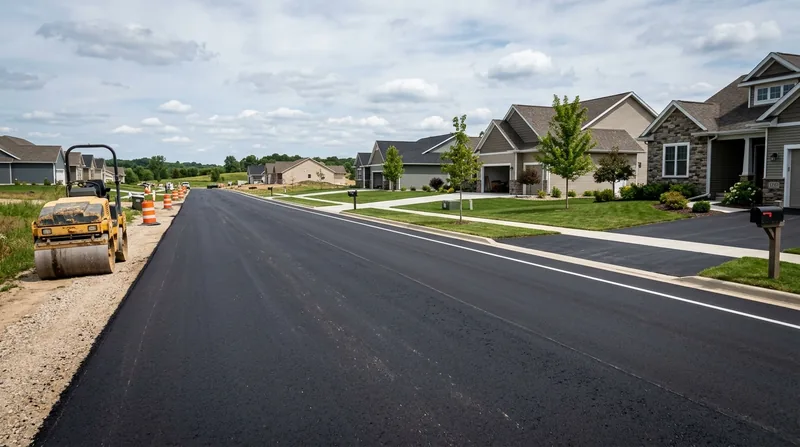




Private Road & HOA Paving in Eau Claire is the backbone of subdivision access and shared community infrastructure. The newer residential developments spreading toward Altoona and Chippewa Falls sit on flatter glacial terrain, but they still face the deep northern frost cycle that dominates this region. When the frost pushes four feet down each winter and the spring thaw comes hard, an undersized or poorly compacted aggregate base will fail in two to three seasons. Private roads and HOA lanes carry repeated traffic from delivery trucks, emergency vehicles, and seasonal snow removal equipment, all of which demand a surface built on a foundation that actually holds. We build deep aggregate bases and pave full-width binder and surface course across the entire road, engineered for the freeze-thaw cycle and the traffic load this market actually sees. Read on to understand how the process works and what to expect.
Why Private Road & HOA Paving Matters in Eau Claire Subdivisions
Eau Claire's newer subdivisions toward Altoona and Chippewa Falls were built with residential streets and shared lanes that looked fine when they were fresh asphalt. But asphalt is not concrete, and it is not a permanent material. After eight to twelve years of repeated freeze-thaw cycles, seasonal salt and snowplow pressure, and the daily weight of cars and service vehicles, the surface develops alligator cracking, potholes, and soft spots that signal the base has begun to fail. At that point, a private road or HOA lane faces a choice: patch the worst spots and watch the rest deteriorate, or rebuild the road with a proper base and fresh asphalt. Most HOA boards and subdivision property managers choose the latter because a failed private road is not just unsightly, it is a liability and a safety issue for emergency access.
- A proper private road base must extend eighteen to twenty-four inches deep to resist frost heave and support loaded trucks.
- Aggregate must be compacted in lifts with a vibratory roller to achieve the density that prevents base failure under traffic.
- Binder and surface course asphalt must be laid hot and compacted while the material is still workable to bond the layers.
- Drainage must be graded to shed water away from the road edge so water does not pool in the base and weaken it during freeze cycles.
- The HOA or subdivision must verify local permitting rules and utility locates before any excavation or grading begins.
A well-built private road carries traffic safely and holds its surface for twelve to fifteen years before resurfacing becomes necessary.
Key info: Eau Claire's frost line reaches four feet deep, and the spring thaw is aggressive. Subdivisions in Lake Hallie, Altoona, and the newer sections of Eau Claire's north side see private road failure driven by frost heave and base saturation, not wear alone. A road that was paved over loose fill or an undersized base will fail in four to six years.
For more on how base preparation and grading affect long-term durability, see our guide to gravel driveway installation and grading.
How We Build Private Roads and HOA Lanes in Eau Claire
Every private road job begins with an on-site walk to measure the full length and width of the road, check the existing grade and drainage, identify any soft spots or drainage issues, and confirm local permitting and utility locate requirements. We then provide a written estimate that specifies the depth of aggregate base, the tonnage of asphalt binder and surface course, and the timeline. Once you approve, we schedule the work and begin with base preparation.
- We remove the existing failed asphalt or prepare the subgrade if the road has never been paved.
- We excavate and grade the road to the proper crown and slope so water runs off the edges and does not pond.
- We bring in compacted aggregate base material, typically recycled asphalt millings or fresh crushed stone, and compact it in lifts with a vibratory roller.
- We lay a hot mix asphalt binder course across the full width and compact it with a mechanical roller.
- We finish with a hot mix asphalt surface course and compact it to achieve a smooth, durable riding surface.
- We verify the finished grade and drainage, and mark any new edge lines or parking areas as requested by the HOA.
The entire process typically takes two to four weeks from the start of base work to the final surface compaction, depending on road length and weather.
Local example: A half-mile private road in a Chippewa Falls subdivision required removal of the failed original asphalt, eighteen inches of compacted recycled millings base, and two courses of hot mix asphalt. The project took three weeks, including grading and drainage correction. The road now carries heavy traffic and seasonal snow removal without cracking or rutting.
For details on how asphalt milling and removal fit into the larger project, visit that service page.
Private Road and HOA Paving Methods
| Approach | Description | Best For |
|---|---|---|
| Full-Depth Replacement | Remove failed asphalt and base, rebuild from subgrade with eighteen to twenty-four inches of compacted aggregate, then pave binder and surface course. | Roads with alligator cracking, potholes, rutting, or a base that has failed due to frost heave or poor original construction. |
| Mill and Overlay | Mill off the top one to two inches of failed asphalt, verify the remaining base is sound, then pave new binder and surface course over the existing base. | Roads with surface distress but a solid underlying base and good drainage, typically after eight to ten years of service. |
| Recycled Millings Base | Use recycled asphalt millings (RAP) as the compacted base material instead of fresh crushed stone, reducing material cost and supporting local recycling. | Budget-conscious HOAs and subdivisions where the base is sound but needs refreshing, or where recycled material meets local environmental preferences. |
| Phased Paving | Divide a long private road into sections and pave in phases over two or more seasons to spread HOA costs and minimize disruption to residents. | Subdivisions with long roads, tight annual budgets, or where residents need continuous access during construction. |
Private Road & HOA Paving Cost in Eau Claire: What to Expect
Private road and HOA lane paving is priced by the linear foot and the width of the road, and the cost depends on the depth of aggregate base, the tonnage of asphalt, the condition of the existing road, and the complexity of drainage and grading. A typical quarter-mile private road with a twenty-foot width and a full-depth replacement can range from $15,000 to $35,000 or more, depending on whether the existing asphalt is milled or removed, whether recycled millings or fresh aggregate is used, and whether drainage work is required. A half-mile road or a road with poor drainage or difficult grading can easily exceed $50,000. The best way to understand the cost for your specific road is to have us visit the site, measure the road, identify the base condition, and provide a written estimate that breaks down the aggregate tonnage, asphalt tonnage, and labor by phase.
Factors that increase cost include deep excavation into difficult soil, poor existing drainage that requires regrading or culvert work, utility conflicts that require careful hand work or relocation, and roads that are longer or wider than average. Factors that can reduce cost include using recycled millings instead of fresh aggregate, phasing the work over two seasons to spread the budget, and roads that already have good drainage and minimal site obstacles. Most HOAs benefit from getting two or three estimates from local paving contractors so they can compare the approach, the tonnage specifications, and the price before committing.
Visit our full pricing overview for more detail on how we structure estimates and what is included at each price point.
Private Road & HOA Paving Near Me: What Eau Claire Homeowners and Property Managers Should Know
Hiring a paving contractor for a private road or HOA lane is different from hiring one for a residential driveway. The road is a shared asset, the work is larger in scope, permitting and utility locates are essential, and the HOA board often has architectural standards or specifications that the contractor must follow. Start by verifying that any contractor you consider is fully insured and can provide proof of general liability and property damage coverage. Ask for references from similar private road or HOA projects in Eau Claire, Altoona, or Chippewa Falls, and call at least two references to ask about the quality of the work, the timeline, and whether the contractor delivered the tonnage and specifications that were promised on the estimate.
Verify with your local city or village that a permit is required for the road work, and confirm whether the municipality requires the contractor to pull the permit or whether the HOA or property manager will handle it. In Eau Claire, Altoona, Lake Hallie, and Chippewa Falls, permitting and utility locate requirements vary by jurisdiction, so do not assume that a road paved in one city follows the same rules in another. Ask the contractor whether they will arrange the Wisconsin 811 utility locate (required by law before any excavation), and confirm that the estimate includes the cost of locates. If the road crosses a culvert or affects stormwater drainage, the municipality may require a stormwater management plan or a drainage easement; ask your city or village and make sure the contractor understands the requirement before work begins.
Request a written estimate that specifies the aggregate base depth and tonnage, the asphalt binder and surface tonnage, the timeline, and any assumptions about utility locates, permitting, or drainage work. Do not accept a price per square foot without tonnage specifications, because that is a sign the contractor has not measured the road carefully or thought through the base depth. Avoid any contractor who offers a price over the phone without visiting the site, demands a large cash deposit before work starts, or has out-of-state plates and no local address. A reputable local contractor will visit the site, provide a detailed written estimate, and be available to answer questions during the project.
For more on how to choose a paving contractor and what to watch for, contact us for a free estimate and we can walk you through the process and answer your HOA or subdivision's specific questions.
Private Road & HOA Paving in Eau Claire: Pricing Guide
| Service | Price | Details |
|---|---|---|
| Quarter-mile private road, full-depth replacement | Starting at $15,000 | Twenty-foot width, eighteen-inch aggregate base, removal and paving, good drainage and no utility conflicts |
| Half-mile private road or HOA lane, full-depth replacement | Starting at $30,000 | Twenty to twenty-four foot width, eighteen to twenty-four inch base, all removal, grading, and paving included |
| Mill and overlay on existing road | Starting at $8,000 | Quarter-mile, twenty-foot width, assumes base is sound and drainage is adequate, no excavation required |
| Complex or large-scale private road project | On estimate | Long roads, difficult drainage, utility conflicts, poor soil, or phased work require site visit and detailed tonnage calculation |
| Utility locate and permitting assistance | Included | Wisconsin 811 locates arranged before excavation, coordination with local building department, no separate fee |
| Free on-site estimate | Free | Includes road measurement, base assessment, drainage review, and written tonnage specification, no obligation |
Indicative pricing, the exact cost depends on square footage, finish, and site access. Free personalized estimate within 24h at (534) 444-7192.


